Yang Tai Chi rests on thirteen movements of energy: eight for the hands and five for the steps. Every form, weapon and push hands drill I am learning comes back to them. The old texts match the eight to the trigrams of the Book of Changes and the five to the five phases.
掤、捋、擠、按、採、挒、肘、靠,此八卦也;進步、退步、左顧、右盼、中定,此五行也。
“Ward off, roll back, press, push, pluck, split, elbow and shoulder: these are the eight trigrams. Advance, retreat, look left, gaze right and central equilibrium: these are the five phases.”
The Taijiquan Classic, traditionally credited to Zhang Sanfeng
Four main directions (peng, lu, ji, an) and four corners (cai, lie, zhou, kao). The first four are the heart of Grasp Sparrow's Tail and of two-handed push hands.
掤
Peng · Ward off
乾 Qian · Heaven
Peng is the buoyant, outward-filling energy that keeps the arms rounded and the whole frame springy, like a ball pumped full of air. It is not a push: it is the structure that meets an incoming force and neither collapses nor stiffens. Teachers say peng should be present in every posture, which is why it comes first of the eight.
In the form: Ward Off left and right at the start of Grasp Sparrow's Tail (攬雀尾); the rounded arms of Single Whip and Brush Knee.
掤勁義何解?如水負行舟。
“What is the meaning of ward-off energy? It is like water bearing up a moving boat.”
Song of the Eight Methods
捋
Lu · Roll back
坤 Kun · Earth
Lu yields. It sticks to an incoming force, turns the waist and draws the force past you and slightly down, so that it lands on nothing. The hands do little; the turn of the waist and the settling of weight into the back leg do the work.
In the form: Roll Back in Grasp Sparrow's Tail; the drawing back in Repulse Monkey.
捋勁義何解?引導使之前。
“What is the meaning of roll-back energy? It leads the opponent forward.”
Song of the Eight Methods
擠
Ji · Press
坎 Kan · Water
Ji joins the two hands, one pressing the wrist or forearm of the other, and sends a short, compact force forward from the legs and waist. It often follows roll back, once the opponent has been drawn off balance.
In the form: Press in Grasp Sparrow's Tail.
擠勁義何解?用時有兩方。
“What is the meaning of press energy? In use it works in two ways.”
Song of the Eight Methods
按
An · Push
離 Li · Fire
An sinks first, then rises and pushes forward, like a wave. It is often taught as a two-handed push, but the classics describe a flowing force that fills whatever gaps it finds, as water does.
In the form: Push at the end of Grasp Sparrow's Tail; Apparent Close-up (如封似閉).
按勁義何解?運用似水行。
“What is the meaning of push energy? It is used like flowing water.”
Song of the Eight Methods
採
Cai · Pluck
巽 Xun · Wind
Cai is a sudden downward pull that catches a wrist or elbow and takes the opponent's balance down and in, like plucking fruit from a branch.
In the form: Needle at Sea Bottom (海底針).
採勁義何解?如權之引衡。
“What is the meaning of pluck energy? It is like the weight sliding along a steelyard beam.”
Song of the Eight Methods
挒
Lie · Split
震 Zhen · Thunder
Lie uses two forces in opposite directions at once, one part of the body going one way and another part the other, so that an opponent is turned or spun off their line.
In the form: Diagonal Flying (斜飛勢); Part the Wild Horse's Mane.
挒勁義何解?旋轉若飛輪。
“What is the meaning of split energy? It spins like a flying wheel.”
Song of the Eight Methods
肘
Zhou · Elbow
兌 Dui · Lake
Zhou is the elbow at close range: when the hands are too close to use, the elbow strikes, presses or turns. Many teachers stress that it is just as much about using the elbow to steer and control as to hit.
In the form: Fist Under Elbow (肘底看捶); the turning elbow in Deflect, Parry and Punch.
肘勁義何解?方法有五行。
“What is the meaning of elbow energy? Its methods follow the five phases.”
Song of the Eight Methods
靠
Kao · Shoulder
艮 Gen · Mountain
Kao is the closest range of all: once hands and elbows have been passed, the shoulder, back or hip leans into the opponent with the whole body's weight behind it.
In the form: Shoulder Stroke (肩靠), after Raise Hands.
靠勁義何解?其法分肩背。
“What is the meaning of lean energy? Its method divides into shoulder and back.”
Song of the Eight Methods
The five steps 五步
The footwork that carries the eight energies. The Song of the Thirteen Postures puts the source of it all at the waist:
十三總勢莫輕視,命意源頭在腰隙。
“Do not take the thirteen postures lightly: the source of intent lies at the waist.”
Song of the Thirteen Postures
進
Jin · Advance
金 Metal
Stepping forward. The heel touches down empty and light, and only then does the weight flow into the front leg, so the step never lands heavily or commits too early.
In the form: Brush Knee and Twist Step (摟膝拗步); Step Forward, Deflect, Parry and Punch.
邁步如貓行,運勁如抽絲。
“Step as a cat walks; move your strength as if drawing silk from a cocoon.”
Mental Elucidation of the Thirteen Postures
退
Tui · Retreat
木 Wood
Stepping back without losing the root. The toe touches first, the weight settles, and the retreat is used to draw an opponent in rather than to run away.
In the form: Repulse Monkey (倒攆猴).
往復須有摺疊,進退須有轉換。
“Going and returning need folding; advancing and retreating need turning.”
Mental Elucidation of the Thirteen Postures
顧
Gu · Look left
水 Water
Gu means to attend or look after. It is attention and movement to the left that stays connected to the centre, never reaching out of balance.
In the form: Cloud Hands (雲手) moving sideways; the turn to the left into Single Whip.
左重則左虛,右重則右杳。
“If weight comes on the left, the left empties; if on the right, the right vanishes.”
Treatise on Taijiquan, Wang Zongyue
盼
Pan · Gaze right
火 Fire
Pan means to gaze or look out for: attention and movement to the right, the partner of gu. Together they train the eyes and spirit to lead each turn.
In the form: Fair Lady Works the Shuttles (玉女穿梭) to the four corners; turning right in Cloud Hands.
仰之則彌高,俯之則彌深。
“Look up and it is higher still; look down and it is deeper still.”
Treatise on Taijiquan, Wang Zongyue
定
Ding · Central equilibrium
土 Earth
Zhong ding is the steady centre the other twelve turn around: the body upright and relaxed, the weight settled, able to move in any direction without leaning. Many teachers count it the most important of the thirteen.
In the form: Every posture; it is easiest to feel in standing (Wuji), Single Whip and Golden Rooster Stands on One Leg (金雞獨立).
立身須中正安舒,支撐八面。
“Stand centred, upright and at ease, able to brace all eight directions.”
The Chinese quotations are from the classical texts; the English translations on this page are our own. The videos are by the teachers named, in their own lineages, which do not always match ours: learn the details from your own teacher.
What I am learning in Tai Chi & Qigong
Curriculum
From Qigong to sticking hands
The syllabus in teaching order, with our class videos and the lineage masters performing each form. Each section also has space for your own notes.
A short note: I am a student, not a teacher. Everything here is my own practice record of what I am learning at Newcastle Tai Chi under Sifu Damon Bramich, with teachers Sue Seivl and Wei Su. The practice sessions are timers to help me train between classes. If you want to learn these forms, please learn them in person from a qualified teacher; some schools are listed under Schools.
楊澄甫 · 太極拳術十要
The Ten Essentials
Yang Chengfu's ten points are the standard every posture in the form is measured against. Each one here with what it means, where it turns up in class, the mistake it usually hides behind, and video to watch it in.
Lineage map
From Chenjiagou to the world
How Yang style travelled from teacher to student and city to city. Drag to turn the globe, then choose a name to see where they taught and what their school offers.
Drag to rotate · scroll to zoom
Loading the globe…
Drag to rotate · scroll to zoom · click a name
Loading the network…
History & books · 歷史
Where Tai Chi comes from
A short history of the art as historians record it, from the Chen village to the Yang family, our Fu line and the world today, then the books worth reading. Legends are marked as legends; each step links to its source.
Legend
Zhang Sanfeng and Wudang
Many schools trace Tai Chi to the Daoist Zhang Sanfeng on Wudang Mountain. It is a cherished story, but there is no historical record linking him to the art. Source ↗
1600s
Chen Wangting at Chenjiagou
A Ming dynasty officer (1580–1660) in the Chen village, Henan, usually credited with creating the Chen family boxing from which every later style grew. Source ↗
1800s
Yang Luchan learns in the Chen village
Yang Luchan (1799–1872) studied under Chen Changxing, then taught in Beijing, where the art spread beyond the village and became Yang style. Source ↗
Mid-1800s
The Tai Chi Classics
The treatise credited to Wang Zongyue was found in a Beijing salt shop by Wu Chengqing, brother of Wu Yuxiang. With writings by Wu Yuxiang and his nephew Li Yiyu, it became the core theory every style studies. Source ↗
Late 1800s
New styles branch off
Wu Yuxiang, a student of Yang Luchan, founded Wu (Hao) style; Wu Quanyou and his son Wu Jianquan, from the Yang circle in Beijing, gave rise to Wu style; and Sun Lutang (1860–1933) later created Sun style. Source ↗
1920s–30s
Yang Chengfu opens the art to the public
Yang Luchan's grandson Yang Chengfu (1883–1936) standardised the large-frame form taught today and taught it widely across China. His student Chen Weiming recorded his Ten Essentials in 1925, and his own books followed in 1931 and 1934. Source ↗
1940s–60s
Fu Zhongwen in Shanghai
Fu Zhongwen (1903–1994), Yang Chengfu's student and relative by marriage, taught the long form in Shanghai and published his manual of the 85-movement form in 1963. Source ↗
1956
The 24-movement simplified form
China's sports authorities built a short standard routine from the Yang long form. It is now one of the most widely practised Tai Chi forms. Source ↗
1964
Tai Chi reaches the West
Cheng Man-ch'ing, another of Yang Chengfu's students, began teaching his 37-posture form in New York, one of the main routes by which Tai Chi spread outside Asia. Source ↗
1989
Our line comes to Australia
Fu Zhongwen's son Fu Shengyuan (1931–2017) taught in Perth from 1989. Newcastle Tai Chi's line comes through him; see the Lineage page.
1999
World Tai Chi & Qigong Day
Held on the last Saturday of April each year, with events in around eighty countries. Source ↗
2020
UNESCO recognition
Taijiquan was added to UNESCO's Representative List of the Intangible Cultural Heritage of Humanity. Source ↗
Books
Free to read online
Paul Brennan's translations of the original Chinese texts.
The Tai Chi Classics ↗The short theory texts behind every style: the treatises, the Thirteen Dynamics and the Song of Pushing Hands.
Schools and associations with a verifiable teaching line back to the Yang family. Links were checked in September 2026.
School
Lineage
Based in
Links
Schools count generations differently, so they are shown here as a guide only. To suggest a school or a correction, add it to the lineage data file.
太極 · 氣功 · Solo practice
Tai Chi & Qigong Practice
The Yang 8 Form, Warm-ups, Lotus Qigong, Shibashi, Ba Duan Jin, Five Element Qigong and the 18 Luohan Hands at a steady pace. Every move has its own time within the session; five beats mark the change to the next move, and the voice can name each one as it begins.
A short note: I am a student, not a teacher. These sessions are timers for my own practice of what I am learning at Newcastle Tai Chi under Sifu Damon Bramich, with teachers Sue Seivl and Wei Su. The 18 Luohan Hands is my own practice and is not taught at Newcastle Tai Chi. If you want to learn Qigong, please learn it in person from a qualified teacher; some schools are listed under Schools.
Tai Chi Association of Australia
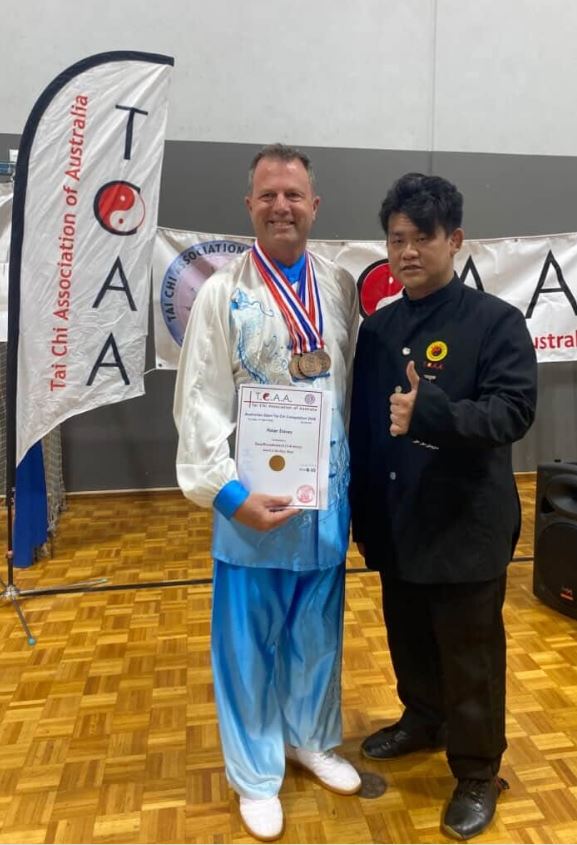
TCAA competitions
Results and photos from Tai Chi Association of Australia championships.
Gold, silver and bronze
2026 · Australian Open Tai Chi Championships
Hurstville Aquatic and Leisure Centre, Sydney · Sunday 12 April 2026 · 40 competitors and 10 teams
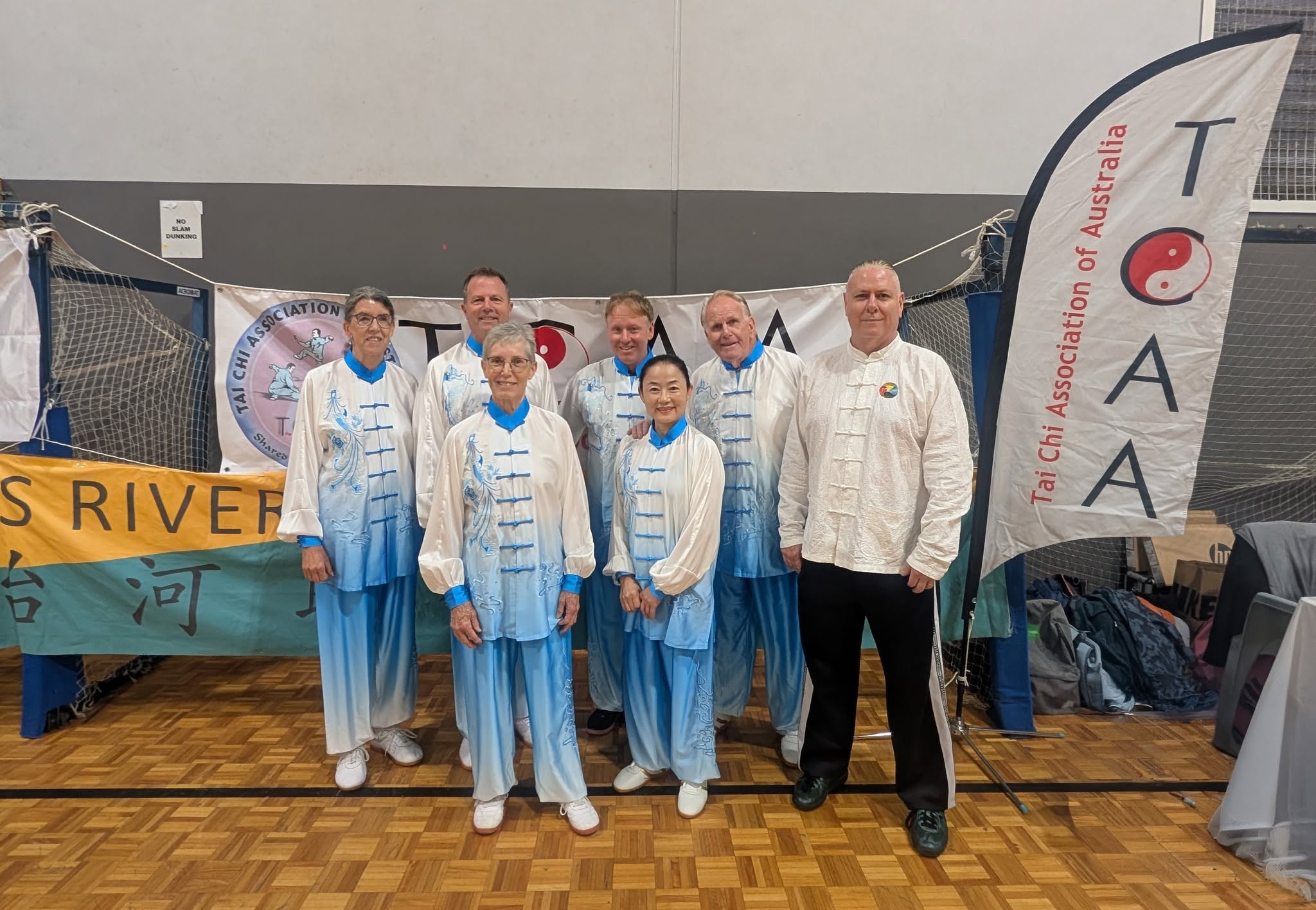
Gold Yang 28 Form, group · Newcastle Tai Chi team
Bronze Yang 28 Form, solo male · Peter Davey
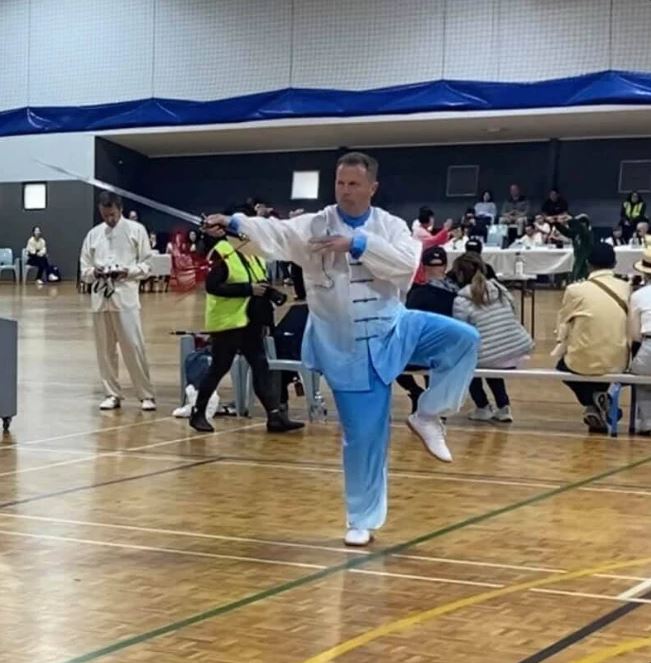
Bronze Sword Form · Peter Davey
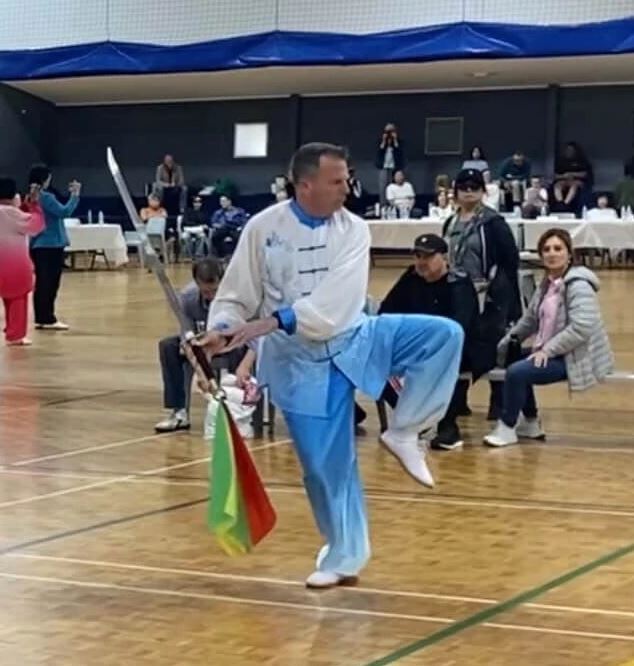
Bronze Sabre · Peter Davey
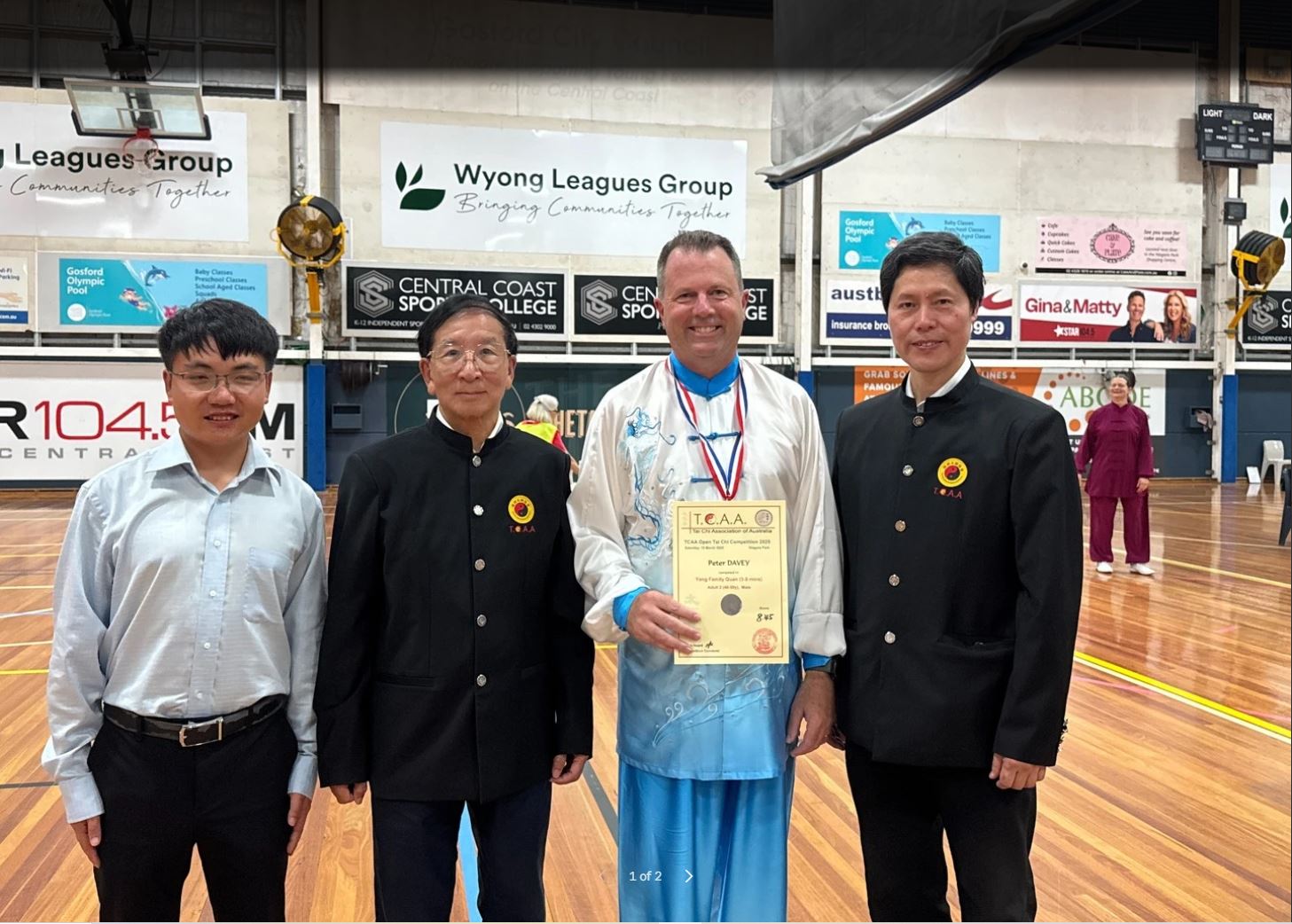
2025 · TCAA Open Tai Chi Competition
Niagara Park, Central Coast · Saturday 15 March 2025
Silver Yang Family Quan, solo male, 46–59 · Peter Davey · score 8.45